
A variety's name tells you almost nothing. Its lineage tells you everything — where it came from, how it was built, and whether it can be trusted to breed true. Learning to read one is the single most useful skill a serious collector can develop: it turns a label into a documented history, and separates a genetic worth preserving from a marketing story. This guide explains what a lineage records, how to decode the notation breeders use, how to spot a well-documented family from a vague one, and why — at APEX DNA, working with Swiss heritage genetics held since 1994 — an open, traceable lineage is the whole point.
A lineage is a family tree
At its simplest, a lineage records the parents of a variety, their parents, and so on back toward the founding genetics. Each junction is a decision a breeder made: which mother, which father, which trait to chase, which offspring to keep and which to discard. Read from the founders down, it is the biography of a plant — a record not just of what a variety is, but of every choice that produced it.
This matters because a plant's identity lives in its ancestry. Two seeds can carry the same fashionable name and be genetically unrelated; two others can look different yet share a documented parent. The name is marketing. The lineage is evidence. Understanding one is how you tell a preserved stabilised line from a lucky one-off cross.
Reading the notation
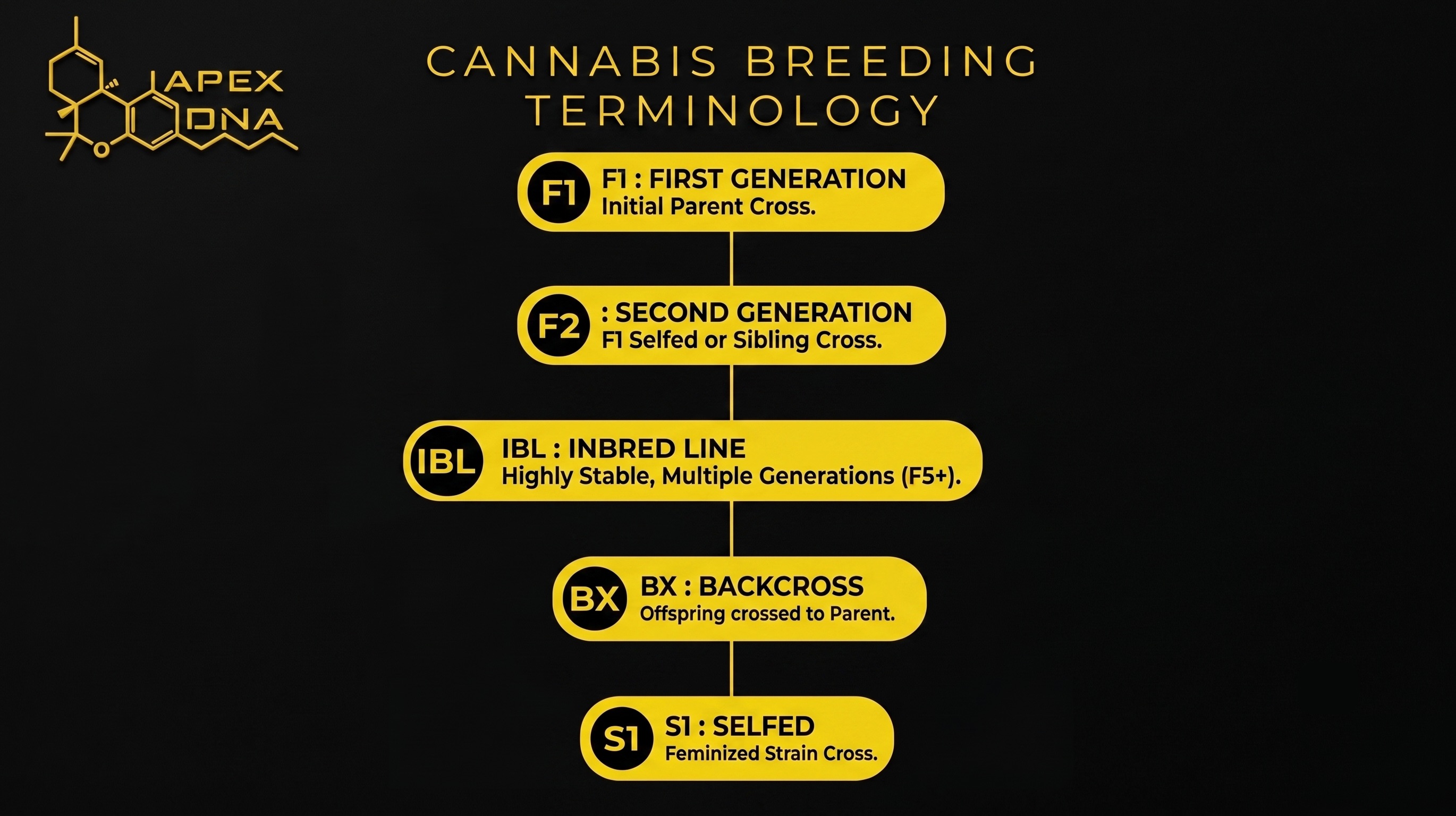
Breeders use a compact shorthand to write down how a line was built. A handful of conventions recur, and once you know them a lineage reads like a recipe:
- A × B — a cross between two parents, A and B. The order sometimes signals which was the mother (named first) and which the pollen donor.
- F1, F2, F3… — filial generations. F1 is the first cross of two distinct parents; F2 is the offspring of two F1 plants; and so on. An F1 is uniform but scatters in the F2, which is why the generation number matters.
- BX1, BX2, BX3… — backcrosses to a recurrent parent, each step concentrating that parent's genetics (roughly 75%, 87.5%, 93.75%) to lock in a specific trait.
- S1 — the offspring of a plant selfed (pollinated with its own pollen), often used to reveal recessive traits or work toward feminised seed.
- IBL — an inbred line, stabilised over many generations until it breeds true.
Read together, these symbols are not decoration — they state exactly how a plant was made, and how far its stabilisation has actually been carried.
How to read a lineage critically
Knowing the symbols is only half the skill; the other half is judging what a lineage does and does not tell you. A few habits separate a careful reader from a credulous one.
Look for depth, not just names. A lineage that lists impressive parents but stops there says nothing about stabilisation. One that records generations — F-numbers, backcrosses, selection notes — describes a genetic that was actually worked, not just crossed once.
Watch for gaps. A missing parent, an undated cross or an ancestor described only by a fashionable nickname is a place where the record thins. Honest lineages name what is known and are candid about what is not; a chain is only as trustworthy as its weakest documented link.
Distinguish a family tree from a claim. Anyone can print a prestigious name on a label. A lineage becomes meaningful only when it is backed by records — kept mother plants, dated crosses, and ideally verification such as laboratory cannabinoid profiling confirming the line holds steady. Documentation is what turns a family tree from a story into evidence.
A worked example
Put together, the notation tells a story. Read a line described as "(Skunk × Afghani) F1, backcrossed twice to Afghani, then inbred to F5". Decoded, it says: two parents were crossed to make an F1; that F1 was backcrossed to the Afghani parent twice (BX2), pulling the line toward roughly 87.5% Afghani genetics to concentrate its traits; and the result was then inbred across five filial generations to fix it into a population that breeds true. In a single line you learn the parents, the direction of selection, and how far stabilisation was carried — everything the front-of-pack name leaves out.
Why a documented lineage matters
Provenance is only as good as its record. A documented lineage is what separates a preserved genetic from a rumour — it is the difference between owning a variety and owning its verifiable history. It is also what makes a genetic returnable: a line whose ancestry, generations and selections are written down can be understood, trusted and traced by anyone, rather than resting on a single grower's memory. This is the practical core of preservation. A trait is only preserved if you can prove where it came from.
That is why APEX DNA maps every family openly rather than hiding behind names. Its lines descend from Swiss mother plants preserved since 1994 and are carried forward through documented, verified generations — the lineage itself is the guarantee. Explore how the families connect in the interactive lineage map, read how the lines are stabilised in the method, or see the finished genetics in the catalogue.