
Few abbreviations carry as much weight on a cannabis seed label as BX. A line marked BX1, BX2 or BX3 is presented, implicitly, as more finished and more reliably preserved than an ordinary cross — yet backcrossing is among the least explained techniques in cannabis breeding. This guide takes it apart in plain language: the genetics underneath, the arithmetic that produces those numbers, and the practical limits that separate a genuinely stabilised line from a marketing badge. It is the same discipline APEX DNA applies to Swiss heritage cannabis genetics preserved since 1994.
Why one exceptional plant is not a line
Every serious breeding project begins the same way. A breeder grows out a population and, among dozens or hundreds of individuals, one plant stands apart: an unusually dense coat of resin, a specific terpene signature, an early finish, a resistance the others lack. The instinct is to keep that plant — but a single plant is not a line, and understanding why takes a short detour into genetics.
Every trait is governed by genes, and each gene exists in variant forms called alleles. A cannabis plant carries two copies of each gene, one from each parent. When the two copies match, the plant is homozygous for that gene and passes it on faithfully. When they differ, it is heterozygous — and here is the problem: a heterozygous plant does not breed true. Its seeds reshuffle the two alleles, so its offspring scatter across a range of outcomes, many of which lose the very trait that made the parent special. Most standout individuals found in a population are heterozygous at many of their genes, which is why a remarkable plant, crossed casually, rarely reproduces itself. A backcross is the tool that converts one plant's qualities into a stable, repeatable line.
The recurrent parent: the keeper clone
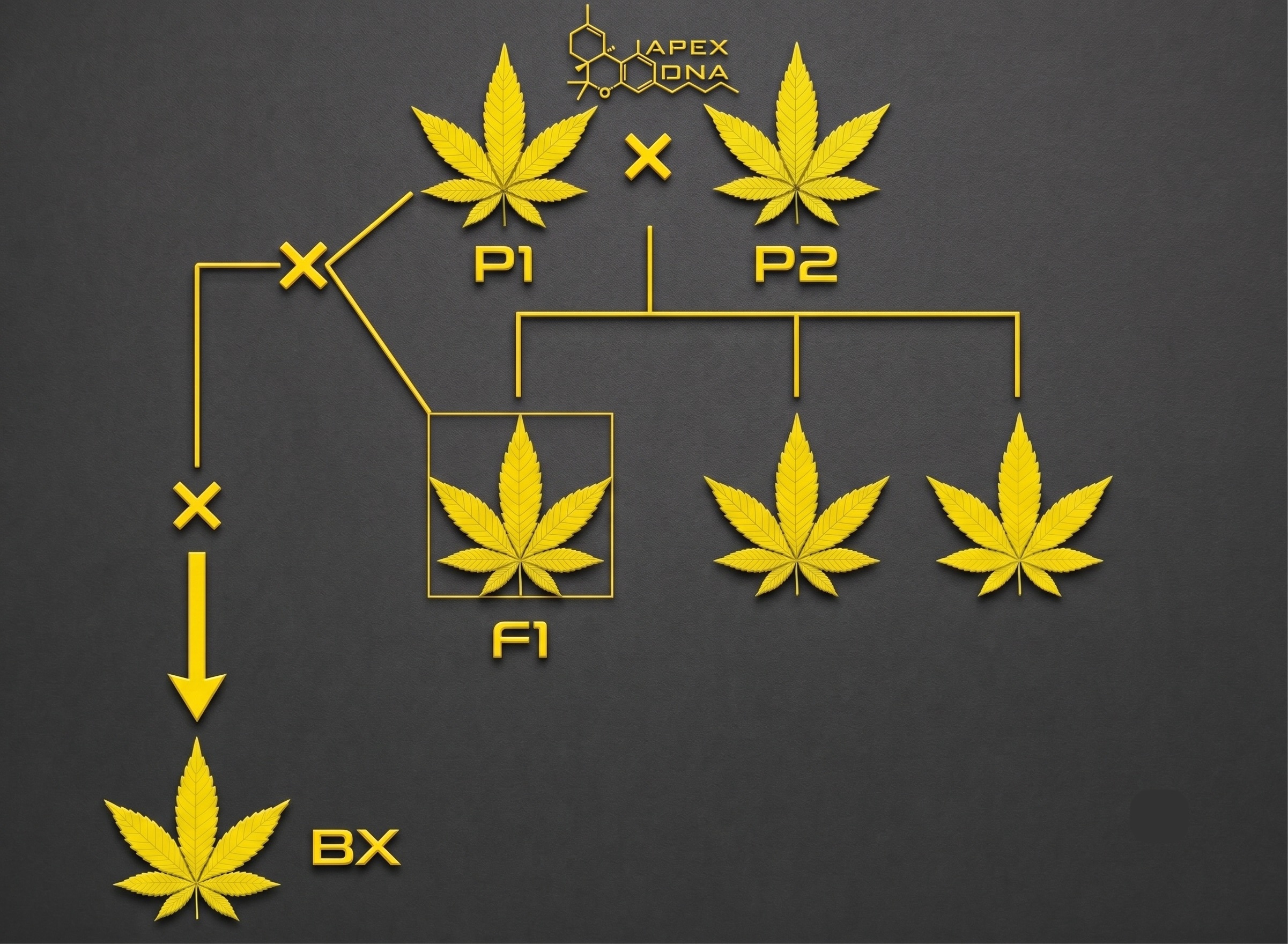
A backcross means crossing offspring back to one of their own parents — specifically the parent carrying the trait worth preserving. That parent is the recurrent parent, and in practice it is almost always held as a clone: a mother (or father) plant kept alive vegetatively, genetically frozen, so the breeder can return to exactly the same individual generation after generation. Cloning removes a variable — the recurrent parent never drifts, so every backcross is measured against a fixed reference.
There is a further, often-overlooked reason breeders tend to keep the prized plant as the mother. A small fraction of a plant's genetics lives outside the cell nucleus, in the chloroplasts and mitochondria, and this is inherited almost entirely through the maternal line. Holding the keeper as the recurrent mother preserves that cytoplasmic inheritance alongside the nuclear genes — a level of rigour that separates methodical preservation from a casual cross.
The arithmetic behind BX1, BX2, BX3
Each time the offspring are bred back to the recurrent parent, they receive a fresh full set of its genes, which roughly halves the proportion of the other — the donor — parent that remains. The genome-wide recovery of the recurrent parent follows a clean formula, 1 − (½)ⁿ⁺¹, and the numbers printed on a label come straight from it:
- F1 (the first cross) — 50% recurrent parent.
- BX1 — about 75%.
- BX2 — about 87.5%.
- BX3 — about 93.75%.
- BX4 — about 96.875%.
By the third backcross a line is, on average, almost entirely the recurrent parent — while ideally still carrying the single donor trait the whole exercise was built around. This is precisely the sequence documented, step by step, in the APEX DNA method.
The catch: an average is not a guarantee
Those percentages describe an average across the entire genome, not a promise about any single seed. That distinction is where real breeding lives, and it is why backcrossing is patient work rather than a formula run on autopilot. Three factors do the heavy lifting.
Selection at every generation
A backcross recovers the recurrent parent whether or not the target trait comes along. If the breeder does not actively select — at every single generation — the individuals that still express the trait, it can be silently bred out. This is especially dangerous for recessive traits, which only appear when a plant inherits two copies of the allele. A recessive trait can hide, invisible, in heterozygous carriers that look identical to non-carriers. To find them, a breeder uses a test-cross or a controlled self to expose which plants secretly carry the allele before choosing which to advance. Skip that step and the program runs blind. The gap between what a plant looks like — its phenotype — and what it actually carries, its genotype, is the whole game.
Linkage drag
Genes are not shuffled one by one; they sit on chromosomes, and genes physically close together tend to be inherited as a block. A desirable trait is therefore often dragged along with a chunk of neighbouring donor genes that resist removal — an effect breeders call linkage drag. A line can read 93.75% recurrent parent on paper while still carrying a stubborn stretch of donor DNA riding alongside the very trait it was chasing. Breaking that block apart takes larger populations — more plants means more chances for a rare, favourable recombination — and, in advanced programs, marker-assisted selection. More backcrosses alone will not do it.
A stable recurrent parent
The whole method assumes the recurrent parent is itself genetically known and stable. Backcrossing toward a plant that is already a shifting mixture simply concentrates uncertainty. This is why documented provenance — knowing precisely what the reference plant is — underpins everything that follows.
Backcross, inbreeding and the IBL
Backcrossing rarely works alone. It is worth setting beside its close relative, inbreeding. A backcross concentrates a line toward one parent; inbreeding — crossing siblings generation after generation while selecting hard — fixes traits across a whole population until it breeds true. A rigorous stabilisation program usually combines the two: backcross to recover a prized keeper, then inbreed and select to lock the result into a population that reproduces reliably from seed. That final, true-breeding state is what defines an inbred line (IBL), and it is why a genuinely stabilised line is measured in years and generations, not in a single lucky cross. The difference between a one-generation F1 and a stabilised IBL is exactly this discipline.
You cannot see a genotype — so you verify it
A plant's genes are invisible; only their expression can be observed. Serious preservation therefore leans on three forms of verification working together: careful phenotype selection across large populations; laboratory analysis — HPLC cannabinoid profiling to confirm that a line's THC, CBD and CBG figures hold steady from one generation to the next; and documentation, so that every cross, backcross and selection is recorded rather than remembered. APEX DNA attaches a traceable lot code to each stabilised release for exactly this reason — a genetic identity you can return to, not a claim you have to trust.
APEX DNA in practice
This is not theory borrowed from a textbook. APEX DNA's programs begin from Swiss mother plants preserved since 1994 and carried forward through documented generations. The OG Swiss Erdbeer line, for example, was stabilised across seven filial generations — the kind of horizon backcrossing and inbreeding demand when the goal is a line that truly breeds true. Each step is verified by phenotype and laboratory profile and held to a documented lineage rather than a memory. Trace how these families connect in the interactive lineage map, or see the finished genetics in the catalogue.
What "BX3" should mean to a collector
Read critically, a backcross notation is a statement about method and patience — but only when selection, verification and documentation stand behind it. The percentage alone tells you nothing about whether the target trait was actually kept, whether linkage drag was ever addressed, or whether the recurrent parent was stable to begin with. This is why, at APEX DNA, the guarantee behind a line is never the abbreviation printed next to its name; it is the discipline that produced it — three decades of preserved mother plants, documented generations and verified results. Provenance, not shorthand, is what you are actually collecting. Read the full protocol in the method, or start with the foundations in our guide to IBLs.