

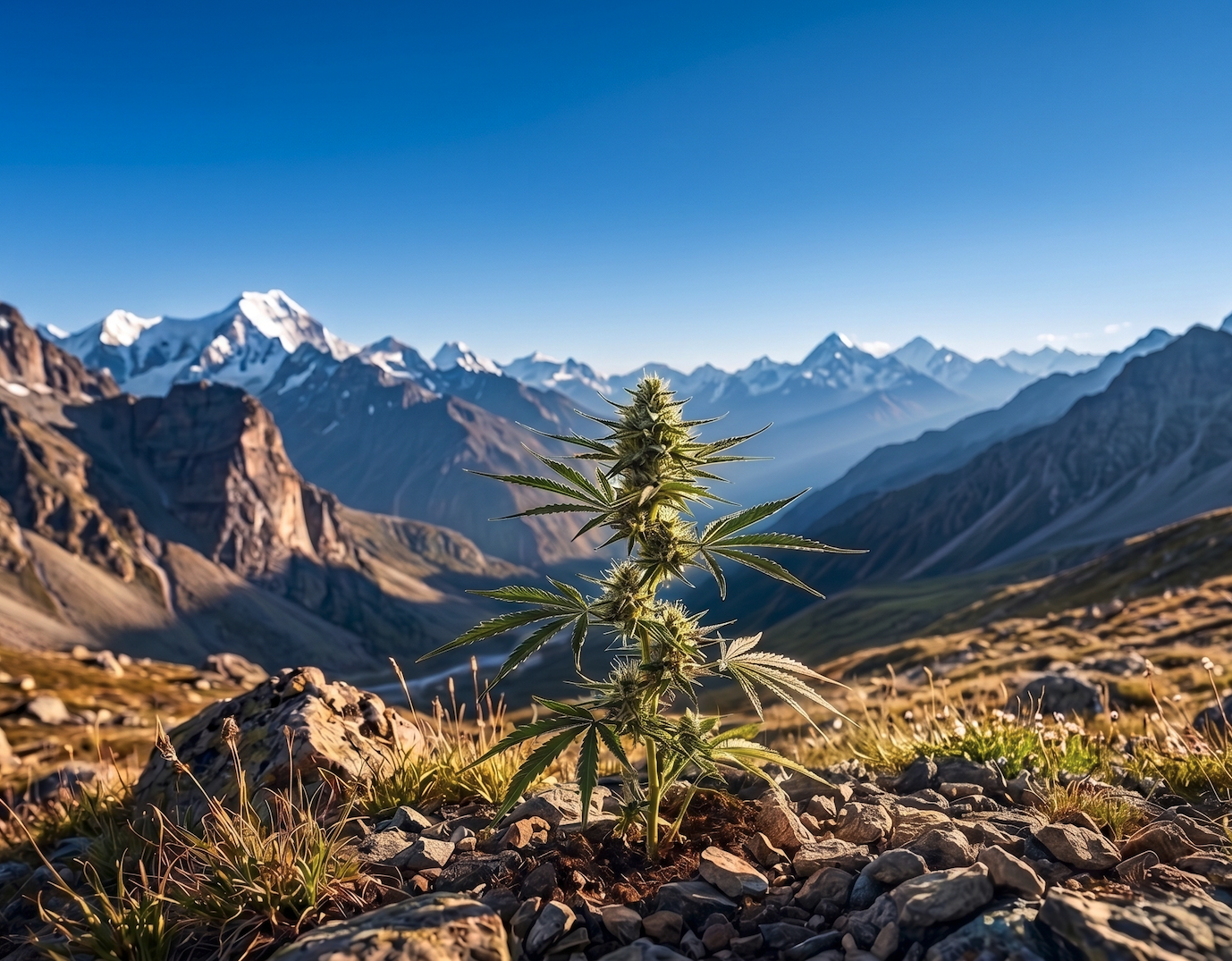
Every modern cannabis variety traces back, sooner or later, to a landrace. Long before breeders crossed plants in controlled rooms, these original populations were shaped by geography alone — and understanding them is the foundation for understanding cannabis genetics at all. This guide explains what a landrace really is, how a place writes itself into a plant's DNA, why these populations are the genetic library everything else draws from, and why preserving them — the same instinct that drives APEX DNA's work with Swiss heritage genetics held since 1994 — is a genuine responsibility rather than nostalgia.
What a landrace actually is
A landrace is a cannabis population native to a specific geography — a mountain valley, a coastal plain, a high plateau — that has grown and reproduced there long enough, in relative isolation, to become genetically distinctive. No breeder designed it. Instead, generation after generation, the local environment did the selecting: the plants that survived the region's climate, altitude, day length, pests and soil left seeds, and those that did not, did not. Over centuries this natural selection narrows a population's genetics until it is remarkably uniform and reproduces true from seed — not because someone fixed it in a program, but because a place fixed it in the wild.
This is why landraces are often described as naturally stable. Isolation limits the introduction of outside genes, and constant selection pressure toward the same local optimum pushes many genes toward homozygosity — two matching copies that pass on faithfully. The result is a population that behaves, genetically, like a stabilised line that nature produced on its own.
How geography writes genetics
The clearest way to see a landrace is to look at how different regions produced different plants. Near the equator, long growing seasons and consistent day length favoured tall plants that flower slowly over many weeks — the classic sativa-type landraces of regions such as Thailand, Colombia or Central Africa. In the mountains of Central Asia — the Hindu Kush running through Afghanistan and Pakistan — short seasons and harsh conditions favoured compact, fast-flowering, heavily resinous plants, the indica-type landraces from which traditional hashish cultures grew. Far to the north, where summers are brief, populations of ruderalis adapted to flower by age rather than by day length at all — the trait that later made auto-flowering varieties possible.
These categories are not marketing labels but records of adaptation, which is exactly why the popular indica / sativa / ruderalis shorthand originally meant something concrete: it described where a landrace came from and how it grew. Photoperiod response, flowering time, plant structure, resin production and terpene profile were all tuned by the environment, and all of it is heritable — written into the population's genes.
Why landraces are the genetic library of the species
Because they were tested by real conditions over long periods, landraces carry deep, resilient gene pools. Traits that a modern grower prizes — disease and pest resistance, drought tolerance, distinctive terpene expression, particular cannabinoid ratios — frequently originate in a landrace that survived precisely because it had them. This is the practical value that makes landraces the raw material of breeding: nearly every hybrid and every inbred line (IBL) reaches back, somewhere in its lineage, to landrace foundations. When a breeder needs to introduce resilience or a rare aromatic note, the landrace gene pool is where it is found.
There is also a diversity argument. A landrace is not a single clone but a population, holding a wide range of allele combinations within it. That genetic breadth is a reservoir — the wider the reservoir, the more raw variation future breeding can draw on. Narrow it, and options close permanently.
Genetic erosion: what is quietly being lost
That reservoir is shrinking. As landrace habitats are developed, as local farmers replace traditional populations with higher-yielding imported hybrids, and as decades of prohibition disrupted traditional cultivation, original landrace genetics have been steadily crossed away or lost outright — a process conservation biologists call genetic erosion. The danger is subtle: a landrace does not vanish in a single event. It disappears one cross at a time, as its unique combinations of alleles are diluted into hybrids until the original population no longer exists anywhere in pure form. Once gone, those specific combinations cannot be recovered — they were the product of centuries that will not be repeated.
Preservation as a discipline, not a sentiment
Preserving a landrace — or any heritage genetic — is more than keeping a bag of old seeds. Serious conservation works on two fronts: in situ, protecting populations where they still grow, and ex situ, holding them outside their habitat as living mother plants and carefully stored seed. Both demand the same rigour: keeping a line true rather than casually crossing it, documenting its origin and every generation, and verifying that its defining traits hold steady over time. Without documentation, a preserved genetic is only a claim; with it, it becomes a genetic identity that can be returned to.
This is the exact instinct behind APEX DNA. The house works from Swiss mother plants preserved since 1994, carried forward through documented generations and kept true rather than diluted — applying the ethic of landrace conservation to a specific Swiss patrimony. Each stabilised line is held to a documented lineage and verified by phenotype and laboratory profile, exactly as rigorous preservation demands, and detailed in the method.
Landrace, heirloom and heritage line: not the same thing
Three terms are used loosely, and separating them sharpens what preservation actually means. A landrace is a wild-adapted population shaped by a place, as described above. An heirloom is typically a landrace — or a very early, stable variety — that growers carried out of its native region and maintained by hand over generations, often far from where it began. A heritage line is a genetic deliberately preserved and stabilised as a documented programme: selected, sometimes backcrossed, verified and recorded. The common thread is fidelity — keeping the genetics true rather than casually blending them — but only the documented heritage line comes with a traceable record. In practice, long-term preservation also depends on unglamorous rigour such as correct seed storage, without which even the finest genetics degrade in a drawer.
What this means for a collector
A landrace is a piece of living history — a population that a place spent centuries writing. For anyone who values cannabis genetics as heritage rather than as a commodity, that history is the point. It is also why provenance matters more than any label: a genetic is only as trustworthy as the record behind it. A preserved, documented heritage line carries not just a set of traits but the story of where they came from — and that story, kept true, is what preservation actually protects. See how these families connect in the interactive lineage map, or explore the finished genetics in the catalogue.