
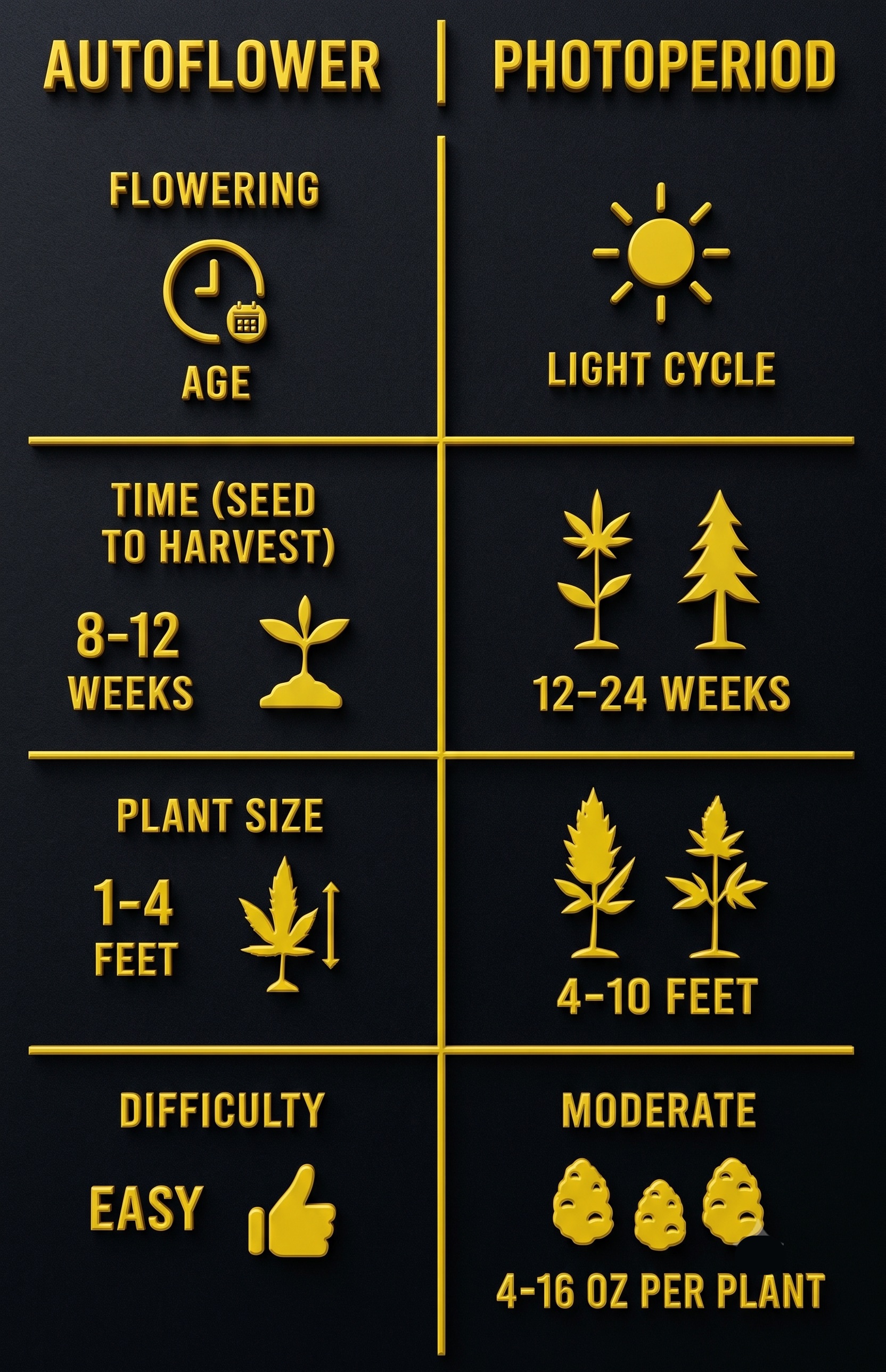
Ask what separates two cannabis genetics and the answer is usually about aroma or structure. But there's a more fundamental split, written into the plant's clock: whether it flowers on a light schedule or on its own internal timer. That's the difference between photoperiod and autoflowering lines.
Photoperiod genetics
A photoperiod plant flowers in response to light — specifically, to longer nights. Outdoors, shortening days trigger the shift; the plant follows the season. This is the classic behaviour of most heritage genetics, and it gives a breeder fine control over the timing and length of flowering.
Autoflowering genetics
An autoflowering line flowers on age rather than light, moving into bloom after a set number of weeks regardless of the schedule. This trait traces back to Cannabis ruderalis, a hardy northern subspecies adapted to short, bright summers. Crossed into modern lines, it produces genetics that run on their own clock.
What it means for a line
Neither is superior — they're different tools. Photoperiod lines reward patience and control; autoflowering lines trade some of that control for independence from the light cycle. The trait is heritable, and stabilizing it cleanly into a line takes the same careful selection as any other stabilized trait.
- Photoperiod: flowers on light; season-driven; classic heritage behaviour.
- Autoflowering: flowers on age; ruderalis heritage; independent of the light cycle.
Explore how our genetics are classified in the catalogue, or follow their ancestry in the lineage map.